We're two brothers who got tired of managing a building with Excel and WhatsApp — so we built a platform for communities everywhere.
Nizam isn't a big company with a big story. It's a small, honest team that started with one building in Karachi and built the tool we wished we'd had — now designed for any residential community, in any country, in any currency.
Why Nizam exists
My name is Neeraj, and I'm the founder of Nizam. Before any of this was a company, it was just a problem I couldn't stop running into.
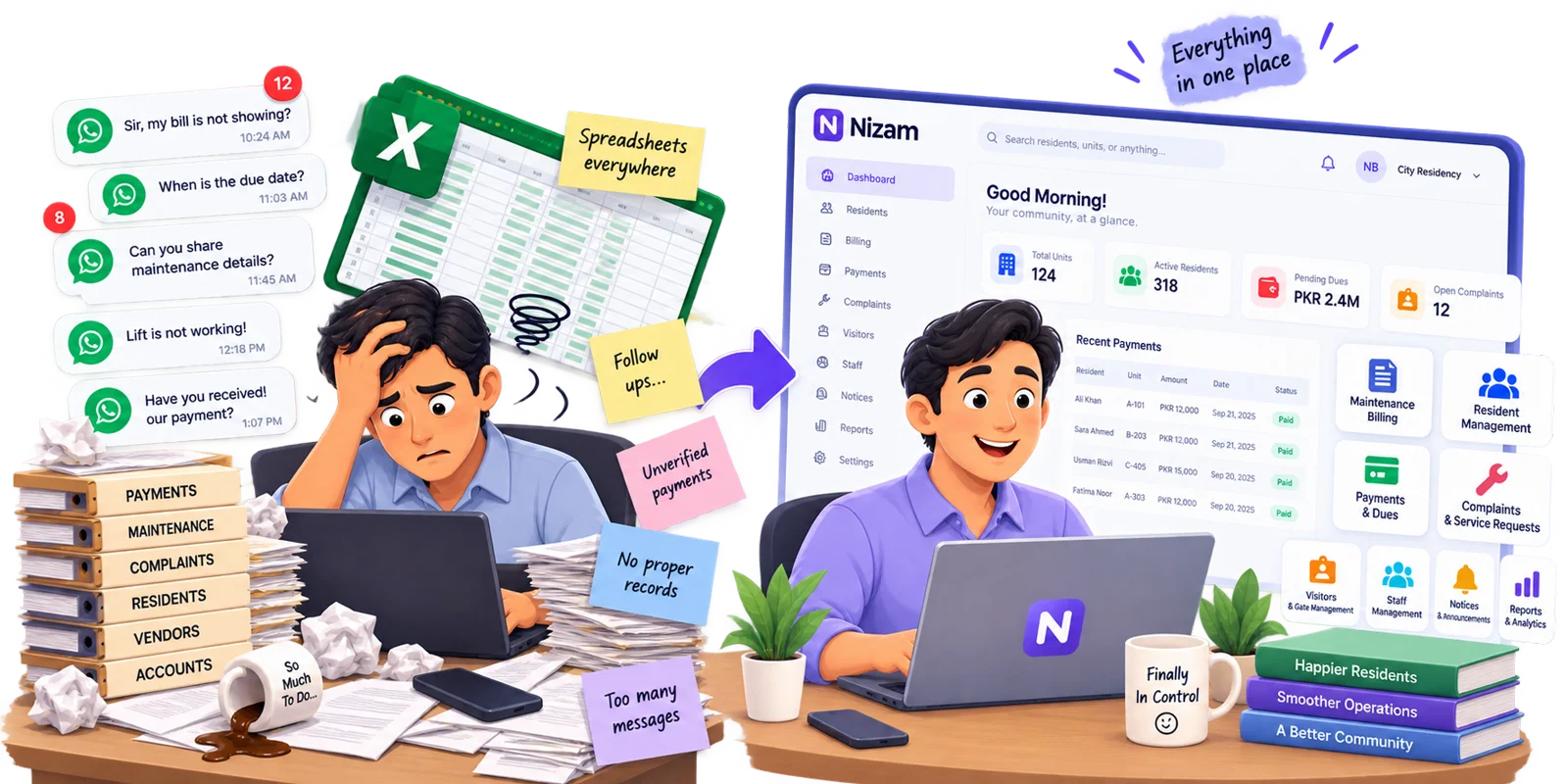
I live in City Residency East Garden, a 124-flat building in Karachi. A few years ago, I volunteered to take on the role of accountant and treasurer for our building's management — no salary, no software, just a sense of responsibility and a lot of spare evenings. For about a year, I ran everything on Excel: maintenance dues, expenses, who'd paid and who hadn't, all in spreadsheet tabs I maintained myself.
It worked, in the way that duct tape works. But the cracks showed up fast. Outstanding dues were a nightmare to track properly — I'd lose time each month just reconciling who actually owed what. Residents had no real visibility into where their money was going, which meant every decision I made was one more thing I had to explain and defend, even when I'd done nothing wrong. And without a transparent, shared system, small misunderstandings kept turning into trust issues between residents and management — issues that had nothing to do with anyone being dishonest, and everything to do with nobody having a clear, shared record to point to.
I'm a software engineer by profession — I've spent 5+ years building software, including at Bykea. So somewhere in the middle of another frustrating month of manual reconciliation, the obvious question hit me: I build software for a living. Why am I doing this by hand?
That question became Nizam. I started building it to solve my own building's problem first — real accounting instead of spreadsheet guesswork, dues that residents could actually see, and a system that didn't depend on residents just trusting me because I said so.
My younger brother Sundesh, also a software engineer, joined me to help build it properly. In May 2026, we launched Nizam. Today, it's managing 500+ units across 2 societies — still early, still growing, but already doing exactly what we set out to do: replace guesswork with a system every resident and every committee can actually trust.
We built Nizam around our own building because that's the problem we knew firsthand — but the underlying problem isn't a Karachi problem, it's a global one. So from early on, we built Nizam to work for any residential community, anywhere: 170+ currencies, terminology that adapts automatically whether you'd call it an "HOA," a "Strata," or a "Housing Society," and support for multiple languages. Where we happen to be based has never been the point — what the product does for the community running it is.
— Neeraj Batheja, Founder
From one building to two societies
Manually managing dues and expenses for a 124-flat building, one spreadsheet tab at a time.
Outstanding dues, no visibility, no trust — a tooling problem, not a people problem.
Built with my brother Sundesh, starting with the exact building where the problem began.
Still small, still growing — and still run by the same two people who started it.
The people behind Nizam
No corporate bios — just who we are and what we've done.

Graduated in Computer Science from FAST-NUCES Karachi, and currently pursuing a Master's in Computer Science at FAST-NUCES. 5+ years in software development, including ~3.5 years at Bykea — Pakistan's ride-hailing platform with 10M+ downloads. Built Nizam after a year of managing his own 124-flat building's finances by hand.
[email protected]
Graduated in Computer Science from NED University Karachi. A software engineer with 3+ years of experience, who joined early to help build Nizam properly — from the product itself to the systems that keep it running.
[email protected]What we actually care about
Transparency over polish
We'd rather tell you honestly that we're a small, early team than dress it up. What matters is whether the product actually solves your problem.
Built by people who use it
We didn't design Nizam from a whiteboard — we built it managing our own building first, and we're still the kind of people who'd volunteer to be treasurer.
Trust, not just software
The whole reason Nizam exists is that spreadsheets and group chats can't give residents real trust in their own management. Every feature is judged against that.